Breaking Down Stage Performances
The whole idea behind live entertainment in Japanese pop culture is to get rid of the divide between our realities and the fictional world of manga, anime, and video games. So, how do performers do it?
2.5D Theatrical Adaptations
Have you ever wanted to see a character from a game or anime in real life? Well, that is exactly what these adaptations do. They cast actors who match animated characters in every way, from facial structures to voices. In this way, when these actors act out scenes from the animations, they feel and look realistic. But the fun does not end there. These actors are also able to walk off the stage and interact with the audience, making these experiences wholesome for the audience. Often, these events appeal most to devoted fans of the original anime or manga as well as gaming communities, and they thus tend to attract a very enthusiastic crowd.
Franchise Concerts
Rather than setting up adaptations, franchise concerts use the actual voice actors in the anime or video games to put on a live show. These actors get to perform in front of the audience while singing the exact songs from the franchise and wearing the same costumes their characters wear. So, while they may not look like the characters per se, the fact that the audience can recognize their voices makes these experiences feel legitimate because the voice actors are the actual characters.
Conventions and Music Festivals
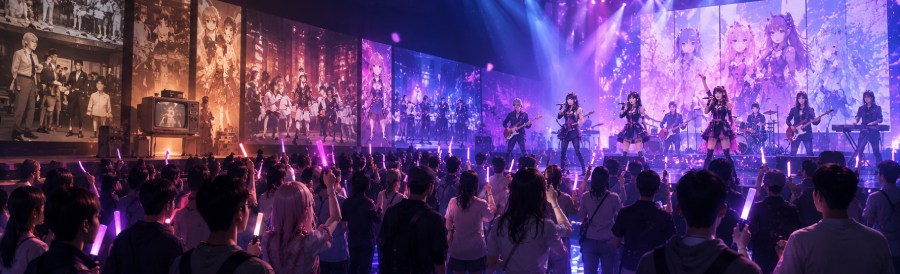
Often, conventions choose to go big by hosting Japanese rock and pop bands in their events, especially when setting up a global convention. These well-known artists are able to perform the opening and closing themes of the most popular anime series, and in so doing, they invite the audience to participate in the songs. People in the crowd get to wave penlights (Anisong for anime or Wotagei for fan dances) or sing along to the music (calls), which makes it feel like they, too, are part of the experience. In fact, in many cases, the audience rehearses the songs before they begin by memorizing the colors for each character and song so that they can change their penlight colors to match the song or determine which responses to give to the singers on stage.
Competitive and Cosplay Stages
In the above categories, professional actors and singers get to take the lead. But can audiences do the same? Of course. In events such as Cosplay Summits, audiences are often invited to participate in activities such as group acts, cosplay performances, and character presentations, where they can present their own takes from anime scenes, video game scenes, and so on. Given the complexity of these scenes, performers often have to invest a lot in aspects such as lighting and costumes to make sure that their acts stand out. It is a fun way for audiences to live out their favorite scenes while interacting with other people who are just as passionate about the anime, manga, or video game worlds.
Community Showcases
Japanese pop culture is so big that it boasts subcultures of its own. And it is not uncommon for creators to put on local events where they put on anime shows or remix music from their favorite shows. Since these events are run and supported by locals, they are more of friendly events where everyone gets to be part of the showcase.
Regardless of the type of live stage performance, the premise remains the same, which is to ensure that the audience is part of the experience.